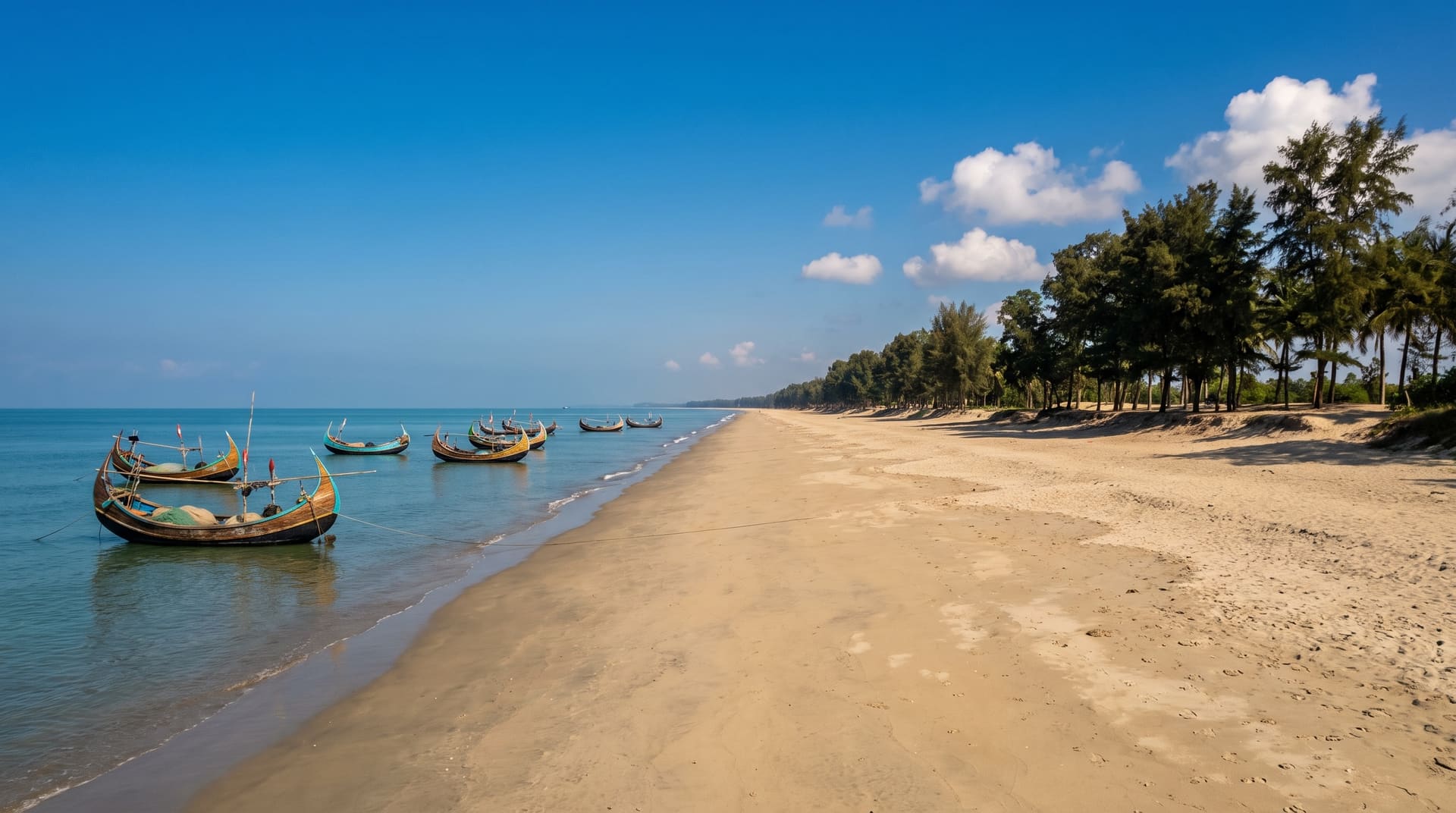
Cox's Bazar weather by month
Cox's Bazar runs from about 19°C in January to 29°C in April, with July the wettest month at 913 mm.
warmest month
April
29°C
coolest month
January
19°C
wettest month
July
913 mm
worst air month
January
58 µg/m³
The whole year, month by month.
| Month | Avg temp | Rain | Sun | PM2.5 |
|---|---|---|---|---|
| January | 19°C | 4 mm | 290 h | 58 |
| February | 22°C | 5 mm | 293 h | 57 |
| March | 25°C | 17 mm | 310 h | 37 |
| April | 29°C | 13 mm | 332 h | 27 |
| May | 29°C | 264 mm | 320 h | 14 |
| June | 28°C | 323 mm | 243 h | 12 |
| July | 27°C | 913 mm | 190 h | 8 |
| August | 26°C | 668 mm | 159 h | 7 |
| September | 27°C | 769 mm | 235 h | 10 |
| October | 27°C | 155 mm | 301 h | 13 |
| November | 26°C | 9 mm | 314 h | 20 |
| December | 23°C | 0 mm | 300 h | 30 |
About 3,287 hours of sun a year. Roughly 167 rainy days a year.
These are long-run climate normals, not a forecast. A given year can sit well outside them. PM2.5 is a global model: near the coast it counts sea salt as fine particulate and reads high against ground stations, sometimes by a factor of two. Use the shape of the year, not the absolute number.